
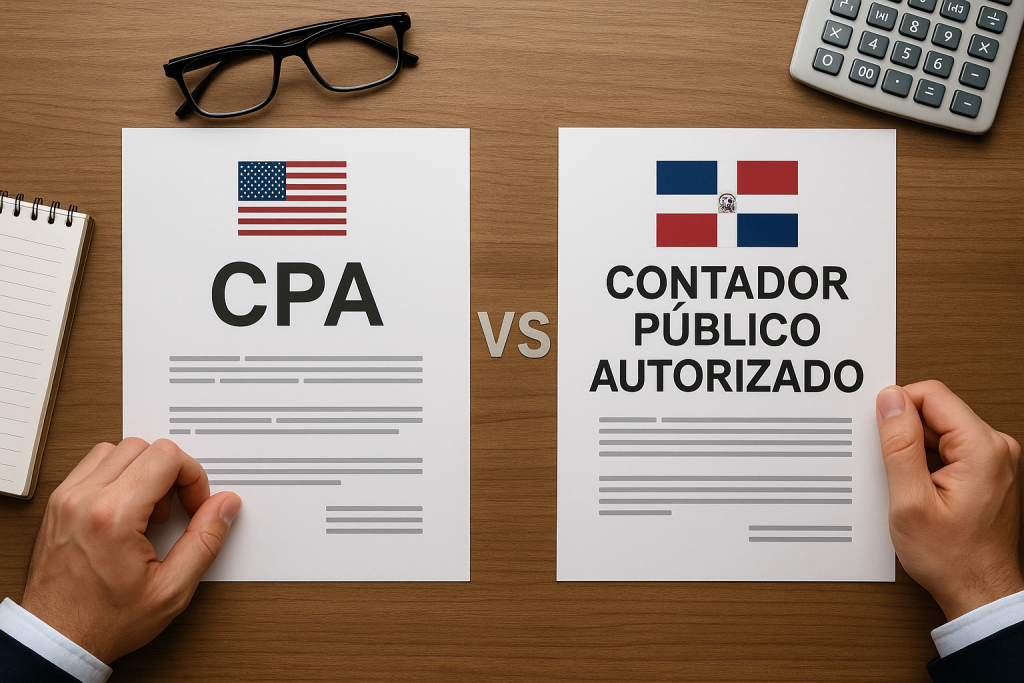
Expanding between the U.S. and the Dominican Republic? You’ll see the acronym CPA in both markets, but it refers to different frameworks. In the U.S., a CPA is a state-licensed Certified Public Accountant. In the Dominican Republic, CPA refers to a Contador Público Autorizado (licensed public accountant). At Henriquez Accounting & Tax Services, we coordinate cross-border bookkeeping, quarterly tax planning, and filings so your U.S. and D.R. obligations stay accurate and aligned. Explore Bookkeeping, Tax Preparation, and Outsourced Controller/CFO.
Licensing Reporting Standards Tax Compliance
US CPAs operate under state boards & US GAAP; Dominican CPAs work under national licensing with NIIF/IFRS and DGII rules.
Quick Definitions
- CPA (USA): State-licensed via a Board of Accountancy; Uniform CPA Exam; continuing professional education. Scope includes financial reporting, tax, audit/assurance (where licensed), and advisory.
- CPA (República Dominicana): Contador Público Autorizado. Professional practice is subject to Dominican authorization, registration, independence, and engagement requirements. A Dominican credential does not confer a U.S. state CPA license.
Side-by-Side: USA vs. Dominican Republic
USA
- Standards: US GAAP for financials; some industries require audits by a state-licensed CPA.
- Tax authorities: IRS + state/local agencies; federal and state income/sales/payroll taxes.
- Common entities: LLC, C-Corp (1120), S-Corp (1120S), Partnership (1065), Schedule C/E for individuals.
- Attest rights: audit/review/compilation per state licensure and firm registration.
Dominican Republic
- Standards: NIIF/IFRS (and NIIF para PYMES) for financial reporting.
- Tax authority: DGII; value-added tax known as ITBIS; invoicing with NCF/e-CF rules.
- Common entities: SRL, SA, EIRL and others under local corporate law.
- Financial statements: Dominican assurance work is subject to local professional rules, applicable standards, independence, and any regulatory requirements for the engagement.
- Labor & payroll: social security contributions via TSS; statutory benefits and filings apply.
U.S. Reporting If You Own a DR Corporation
If you are a U.S. citizen (or resident) with a corporation in the Dominican Republic, you may have U.S. information-reporting obligations:
- FBAR (FinCEN Form 114): foreign financial accounts if the aggregate value exceeded $10,000 at any time in the year.
- Form 8938 (FATCA): specified foreign financial assets if thresholds are met (vary by filing status and residency).
- Form 5471: U.S. persons with interests in certain foreign corporations (control/ownership or category triggers).
Thresholds, categories, and exceptions apply—facts matter. We evaluate ownership, control, and account activity to confirm exact filings and deadlines.
Cross-Border Considerations
- Books & standards: map US GAAP to NIIF/IFRS adjustments (revenue, leases, impairment, FX, etc.).
- Tax coordination: align timing and documentation for US/DR filings; manage NCF/e-CF and ITBIS.
- Transfer pricing: maintain intercompany support; ensure pricing and documentation are defensible.
- FX & cash: USD vs. DOP accounting, translation, and treasury controls.
International Tax Support: Henriquez Accounting reviews U.S.–Dominican cross-border reporting and potential foreign earned income exclusion, foreign tax credits, and home sale exclusion where applicable. Each has separate eligibility rules. The Dominican Republic is not listed among U.S. income tax treaty countries; do not assume treaty relief applies.
Our Cadence (Month–Quarter–Year)
Monthly
- Reconcile bank/credit/merchant accounts; clear Undeposited Funds and
Merchant Clearing. - Deliver P&L, Balance Sheet, Cash Flow; track ITBIS/NCF where applicable.
- US/DR invoice policy: support for NCF/e-CF and US documentation standards.
Quarterly
- US/DR tax projections; safe-harbor estimates; indirect tax (ITBIS/VAT) reviews.
- KPI dashboard: margins, DSCR/runway, DSO/DPO/DIO; pricing/budget updates.
Annually
- US returns (1120S/1065/1120; 1040 Schedules C/E) and tie-outs; DR NIIF/IFRS year-end with DGII compliance.
- 1099 workflow (US) and informative returns (DR) as applicable.
Common Issues We Help Review
- Posting Dominican platform deposits net (burying fees/taxes) → distorted margins; we post gross with clearing accounts.
- Missing NCF/e-CF controls → DGII exceptions and penalties.
- Mismatched US GAAP vs. NIIF policies → lender confusion and rework.
- Weak intercompany documentation → transfer-pricing and withholding exposure.
Operating in the U.S. and Dominican Republic?
We coordinate bookkeeping, standards, and tax workflows across both jurisdictions—so audits, lenders, the IRS, and the DGII all see the same story. Talk to an Enrolled Agent today. Book a 30-Minute Consultation
FAQs
Can a US CPA sign financials for a Dominican company?
Dominican assurance engagements generally require a locally licensed Contador Público Autorizado. A US CPA can advise on US implications and consolidation.
Do Dominican CPAs have attest rights across the country?
Dominican professional authorization is governed by national law. Confirm the accountant’s authorization, registration, independence, and any requirements specific to the engagement. This does not confer authority to perform U.S. CPA assurance engagements.
I’m a U.S. citizen with a DR corporation—what must I file?
Reporting depends on the applicable thresholds and ownership categories. Foreign ownership may trigger information returns such as Form 5471 in addition to applicable income-tax reporting. FBAR and Form 8938 have separate tests and filing routes and do not replace one another. Determine the relevant ownership categories, tax classification and filing year before selecting forms. See Form 5471 instructions and the IRS comparison of Form 8938 and FBAR.
Do US and Dominican accountants use the same standards?
No. US uses US GAAP; the Dominican Republic applies NIIF/IFRS (including NIIF para PYMES). We bridge differences for lenders and tax.
Can you help with treaties, FEIE, and the home sale exclusion?
We review eligibility for the foreign earned income exclusion, foreign tax credits, and the home sale exclusion when relevant. The Dominican Republic is not a U.S. income tax treaty country. Any treaty analysis involving another jurisdiction requires a separate review.
Credentials and sources: Pedro Henriquez is an Enrolled Agent in the United States and a CPA in the Dominican Republic, not a U.S. state-licensed CPA. See IRS preparer credentials, the IRS treaty country list, and ICPARD professional requirements. General information from the Henriquez Accounting Editorial Team; no individual reviewer has been designated.